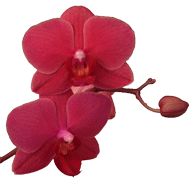




Orchid Care Tips
Orchid care tips and FAQ is what this web site is dedicated to. Here you will find practical tips on how to care for orchids, including orchid care videos that enhance your orchid care experience.
Orchid care is not difficult, it is just different. Orchids have a reputation for being difficult to grow when in fact many varieties make excellent house plants. With proper culture an orchid can be in bloom for months each year and can live indefinitely. In this respect orchids are an excellent value as far as blooming plants go. A well cared for and varied orchid collection can provide continuous bloom every day of the year. Good orchid care requires just some basic knowledge about orchids and how they grow.
The Orchid Family has diverse care needs
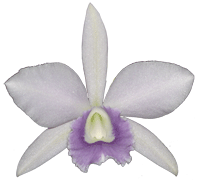
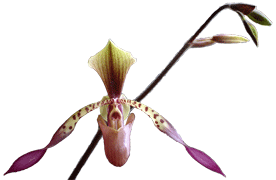 The orchid family has over 880 different types (called genera) and over 22,000 species. These numbers are growing every year making orchids the largest and most diverse of the flowing plant families. In general Orchids are largely tropical plants which live as epiphytes or "air plants" hanging on to trees for support. Some orchids are lithophytes or "rock plants" growing on or among rocks. The remaining orchids are terrestrials which grow in the loamy detritus of the jungle floor. With a plant family this diverse it is challenging to give general guidelines on orchid care. Yet, there are only several dozen species widely produced and even fewer that are available at a local nursery. Our Orchid Identification page provides a basic introduction to many of the popular types of orchids. The plants sold at nurseries, florists, hardware chain stores and groceries are likely to be hybrids. These hybrids have been created by crossing different species, and sometimes different genera to breed in desirable characteristics such as color, fragrance, flower size and ease of care and breed out many of the challenging care aspects of pure orchid species. Todays orchid hybrids are very rewarding house plants to grow and are relatively easy to care for if you take a little time to understand their basic needs.
Orchid Growth Environments as they relate to Orchid Care
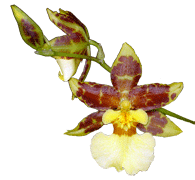 Imagine standing in a jungle and looking up at an orchid that is clinging to a tree. Its roots have grasped the tree bark and are using the tree for support. The orchid gets no nutrients from the tree itself, it is not a parasite, it gets only support and a bit of food from the organic matter decaying in the crooks of branches or from animal droppings that wash down the tree in the rain. It is humid in the jungle and these orchid roots have adapted to absorb water from the humid air, hence the term "epiphyte". Many orchids have to deal with times of abundant water and times of dryness and so they have thick stems called "pseudobulbs" that allow them to store and hold water for the dry periods to come. Imagine now, this same plant in a pot in a typical home environment. How strange this must be for the plant and how different it is from the conditions to which the orchid has adapted. Understanding the natural conditions in which the orchid grows, known as 'in situ', is critical to understanding what the orchid needs for its care.
Orchid Care FAQ
Fundamental to successful orchid care is understanding the requirements of the orchid for support, light, food, humidity, water, air movement and temperature.
What is the best Orchid Mix?
 First and foremost, orchids do not grow in dirt, it will smother their roots and kill the plant. Orchids require special media in which to grow. The best media for an orchid is the one that best matches the type of orchid and the conditions in which it is growing. The conditions on a sun porch in Florida are different from a heated home in Ohio yet orchids, with proper care, can thrive in both. Often multiple media are mixed together in an orchid mix with each ingredient bringing unique desirable characteristics to the mix. The goal is the same, to use a mix that is open and airy and brings to the orchid the appropriate amount of moisture for its needs.
Whether you choose one of our Classic Orchid Mixes, Imperial Orchid Mixes or choose to create your own custom Select-A-Blend, we hope you will see the variety of orchid media and orchid mix ideas available here. Also see our illustration of Orchid Root Size and how it relates to the choice of orchid mix. To better understand the water retention capability of each orchid media please see our Media Weights chart.
What kind of Orchid Pots should I use?
 Orchids do not grow in pots in the wild. We put them in pots for our convenience. As a result we must understand how strange this is for the plant, their roots like to breath and be free. It is perfectly fine for orchid roots to grow outside of the pot. Unfortunately, our homes are not humid enough to support epiphytes well. So, a pot helps by holding some moisture around the roots. The secret to growing healthy orchids is to grow healthy roots. Ordinary potted plants are judged by their leaf growth. For orchids, the root growth is the best indicator of the health of the plant. For orchids grown in pots we must be extra careful not to rot or smother the roots.
Because obtaining a good moisture balance is so very critical to optimal orchid care many orchid growers choose clear orchid pots so that it is easier to see when the roots are thriving and when they are not. It is believed that orchid roots engage in photosynthesis, which makes sense given that they grow exposed to dappled light as the orchid hangs from a tree, and clear pots make photosynthesis by orchid roots possible. White pots also allow some light to pass through them.
Pot your orchids in the smallest pot that the roots will fit in and stake the plant while it establishes itself. The orchids we've seen grow the best are often growing in what appears to be ridiculously small pots so resist the urge to 'pot up' any more than is absolutely necessary to hold the roots. Clear plastic pots make it easy to see the roots and to see when to water. The potting mix turns dark when wet and gradually lightens as it dries. White plastic pots also allow for some photosynthesis while being a very attractive choice for display as well. Unlike clay, plastic pots are easy to clean, disinfect, and reuse. Clear plastic pots are a great way to keep an eye on what is happening in the pot without having to disturb the plant. Exotic Ceramic Pots enhance the beauty of any orchid and are great for displaying a plant in bloom.
What about Orchid Fertilizer?
 Orchids require special fertilizer designed for orchids to grow really well. A common ingredient in many off-the-shelf fertilizer formulas is Urea which is not well absorbed by orchids. As a result, it is best to obtain a fertilizer that is made for orchid care. The gold standard for orchid fertilizer is based upon a formula created as the result of a study at Michigan State University (MSU). Our FEED ME! Orchid Fertilizer is genuine MSU fertilizer from the same folks who supplied fertilizer for the original study. Orchids do not require very much fertilizer; a diluted amount on a regular basis is optimal for orchid care. Most orchid growers recommend fertilizing "weakly, weekly".
When watering flush the plants with water freely. Many people take orchids to the sink in order to flood them with water periodically. Our favorite saying is "once around the bench gets them damp, twice around the bench gets them wet, three times around the bench gets oxygen to the roots". It is oxygen to the roots that orchids need and they will get it from a combination of a good open mix and proper orchid watering habits. For information on fertilizing orchids please see our orchid fertilizing FAQ.
How does humidity and air movement affect orchids?
 Orchids do not like 'wet feet' but they do very much like humidity. As a result, when grown inside a home orchids are often placed on humidity trays. These trays allow water to collect in the base while the plant is suspended above the water. Commercial trays are available or a tray can be created from a cake pan filled with stones or inverted pot saucers, anything to allow the orchid pot to be above a pool of water. In this way the orchid benefits from the evaporation of the water. Orchids also like to be gathered close together as this also helps to raise the humidity among the plants. This is invariably a balancing act because orchids also like air movement but constant movement of dry air will dry out the plants. Too much moisture and too little air movement and the plants may become susceptible to rot. Achieving a good balance of humidity and air movement is one of the goals of successful orchid care.
What are the light requirements of orchids?
 Orchids have very widely varying light needs and understanding the appropriate amount of light for the type of orchid is essential to their care. Even 'high light' orchids do not require the kind of bright direct sunshine that a tomato plant does and even 'low light' orchids will not be happy indefinitely in the middle of a room far from any light source. Even a North window can be too little light for low light orchids to bloom reliably but a South window may need some shading. In fact, it is often inadequate light that inhibits orchid blooming. Some orchids, especially those which like high light levels, enjoy being summered outside in dappled shade and for many high light orchids that is the easiest way, to give them enough light to bloom. If high light orchids are to remain indoors, many will not bloom reliably without some sort of supplemental light unless they are in a very bright sun room or greenhouse. Fortunately, fluorescent bulbs with broad spectrum bulbs work fairly well with orchids, as do High Intensity Discharge (HID) lights. Also, in nature orchids get natural light cues. The days get longer and then get shorter. In our homes we have supplemental lighting and tend to keep a regular schedule year-round and this can throw off an orchid's natural clock.
What temperature do orchids require?
 Some orchids use the chill in the Fall air or the difference between the temperature at night and the temperature during the day as a cue to let them know the seasons are changing and it is time to prepare to bloom. Again, the fact that many people prefer a fairly consistent temperature in their homes is at odds with the orchid's natural environment. That does not mean that all is lost, it is just to emphasize that knowing the needs of the type of orchid that you are trying to provide care for will allow you to make small adjustments to meet those needs and be rewarded with beautiful orchid blooms. Some orchids are naturally warm growing while others are intermediate or cool growing but most will do OK in intermediate conditions where it isn't blazing hot nor near freezing cold. It is good to know the temperate preferences of the orchids in your collection. Often there is some variance, for example, cooler growing orchids can be put closer to a cool window or in a cooler spot in a home.
How should orchids be watered?
 Proper orchid watering is probably the single most difficult aspect of orchid care to get right. The appropriate amount of water for an orchid varies with the type of orchid, the type of mix it is in, and the environment in which the orchid is growing. This is as difficult for beginners as using a recipe that suggests that a dish be "baked until done", what does that mean? Orchids want the 'right' amount of water, not too much and not too little. The right amount also varies with the seasons, orchids dry out more quickly when it is hot then when it is cold. The key is to vary the frequency of orchid watering, the type of pot, the type of mix, how tightly the mix is packed and the amount of air circulation until the right balance is achieved for each orchid. This takes time and patience but pays off with increased health and vigor of the orchid which translates into increased blooms. The one thing to avoid is to limit the amount of water that an orchid is given during a watering. By & large one is met with the greatest success when an orchid is watered liberally, allowing the water to pour from the bottom of the pot, until the plant and media are completely saturated. From a practical standpoint this usually means bringing the orchid to the sink and running water liberally through the mix. In some cases one can water an orchid on its humidity tray especially if that tray has a drain in case the water level gets too high. Once the orchid has been watered it should go back to its growing space until the next watering which may be anything from a few days to a week or more later. Establishing a routine can help, for example watering on the weekend and checking the plants midweek. When in doubt, wait, too little is better than too much.
Any orchid mix can be over watered and lead to the demise of the plant. Most orchids like to get almost dry and then be flooded with water and allowed to get almost dry again. With sphagnum it is easy to tell when they are dry, the moss feels crunchy when you touch it. That's why many growers will recommend it to folks just starting out with orchids, especially phalaenopsis. Fir/coconut mixes can be hard to tell when to water as they hold more water in the center than we often think they do. Sticking a pencil or chopstick down into the mix and leaving it there allows you to pull it out and see if the interior of the mix is wet.
How do you repot an orchid?
 Our Orchid Repotting page provides basic repotting information in FAQ format and our pictorial walk thru illustrates how to repot an orchid. The Orchid Finder provides a pictures of orchids not in bloom to assist in identifying them. To help and choose the recommended blend for an orchid, see our Find the Right Orchid Mix page. Our Orchid Calendar, Orchid Repotting Times, and Orchid Bloom charts describe what to look for and when. Our Orchid Growth page illustrates the differences between sympodial and monopodial orchids.
Help! My orchid is sick!
 Often the first sign of a problem with an orchid's culture is an invasion of bugs or bacteria. Pull infected plants and move them away from others IMMEDIATELY!! Keep it away until treatment is complete. The best defense for fungus/bacterial infections is a good offense. We spray foliage monthly with Physan (1 teaspoon/gallon) as a preventative. Pick up an extra bottle of cinnamon in the spice section of your local grocery store and keep it near the orchids. If you cut on a plant, lightly sprinkle it with cinnamon because it is an effective bactericide/fungicide and it's safe to use. Spray with Physan mixed at 1 Tablespoon/gallon if infection sets in. For bugs we start with a GET OFF ME! cinnamon infusion and step up to a 50/50 rubbing alcohol and GET OFF ME! mixture. We like to put a cinnamon stick in the sprayer to increase the efficacy of the solution over time.
In some cases problems can 'go underground' and move from the leaves into the media and onto the roots. If you have a plant that just doesn't seem to recover it could be because trouble is hiding beneath the surface. In these cases repotting is a good idea and may be the only way to eradicate the problem for good. Sometimes orchids will develop an infestation of what looks like little fruit flies called fungus gnats. These are more than just an annoyance as they feed on tender orchid roots. Natural Fungus Gnat Control is just the ticket for these critters.
Note: If you suspect a virus infection, get the plant tested or destroy it. Most of all, keep it isolated until the verdict is in. Unfortunately, there is no way to visually identify virus from fungus or other damage and no way to cure virus once a plant becomes infected. Because of this, if you do acquire a virused plant it is best to destroy it before the virus is passed on to the rest of the collection.
Use the discovery of a problem to review the plant's culture. Orchids under stress are often very susceptible to bugs and disease in a way that stronger orchids are not. Is there insufficient air movement? Perhaps other plants have gotten the same insect on them? Was a new plant acquired and not quarantined long enough? Were several plants cut on by the same tool without sterilizing in between? Might a nearby house plant be a haven for bugs? Is there too much or too little light?
 Home
Home